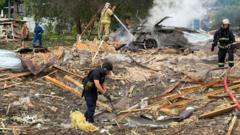
A Romanian air force jet has shot down a suspected Russian drone that violated its airspace, in a serious escalation of tensions raising fears that Moscow’s war on Ukraine could spill over into neighbouring NATO states.
The incident, reported by Al Jazeera, marks a concerning development in the protracted conflict, underscoring the precarious security situation on Europe's eastern flank. Romanian authorities confirmed the drone was intercepted and neutralised over a sparsely populated agricultural area, with no reported injuries or significant damage on the ground. The drone’s origin is still under investigation, however, its flight path and characteristics strongly suggest it was a Russian military unmanned aerial vehicle.
Heightened Vigilance on NATO's Border
The incursion prompted an immediate and robust response from the Romanian air force, acting swiftly in accordance with NATO protocols for airspace violations. A high-ranking defence official, speaking on condition of anonymity, stated that “Romania’s air defence systems were activated, and a fighter aircraft was scrambled to intercept the unidentified aerial object. Our forces acted decisively to eliminate any potential threat to our national security.” The official emphasised Romania’s unwavering commitment to defending its sovereignty and the collective security of the Alliance.
This incident comes on the heels of repeated warnings from NATO and its member states about the risk of the conflict inadvertently — or deliberately — extending beyond Ukraine's borders. The Black Sea region, in particular, has become a flashpoint, with increased naval and aerial activity from both Russian and NATO forces. The economic ramifications of such an escalation could be profound, potentially destabilising commodity markets and impacting global trade. Australian businesses, already grappling with inflation and supply chain disruptions, would likely face further headwinds if the conflict widens.
International Calls for De-escalation
International bodies and numerous countries have swiftly condemned the air space violation, urging all parties to exercise maximum restraint and uphold international law. A spokesperson for the United Nations called for a thorough investigation to ascertain the drone's true origin and purpose, while reiterating the urgent need for a diplomatic resolution to the conflict in Ukraine. The incident is expected to be a key agenda item at upcoming NATO discussions, where member states will undoubtedly reaffirm their collective defence commitments under Article 5 of the North Atlantic Treaty.
Australia’s Department of Foreign Affairs and Trade (DFAT) has advised Australians in the region to exercise a high degree of caution and monitor local media for updates. While the direct implications for Australian citizens are limited, the broader geostrategic consequences of an expanding conflict could have far-reaching effects on global stability and security, potentially influencing everything from international travel advisories to defence spending in Canberra.
Putin's Shadow Over Europe
The drone incident is further evidence of the unpredictable nature of the ongoing conflict and the constant threat it poses to regional stability. Analysts suggest that such incursions, whether intentional or accidental, serve to test NATO's readiness and potentially sow discord among its members. The cost of a broader conflict, both in human lives and economic terms, would be catastrophic, dwarfing the billions of Australian dollars already committed to humanitarian aid and military support for Ukraine.
As the war grinds on, incidents like this underscore the critical importance of robust deterrence and effective communication channels between major powers. The international community watches with bated breath, hoping that cooler heads will prevail and prevent the current hostilities from spiralling into an even more widespread and devastating confrontation.