
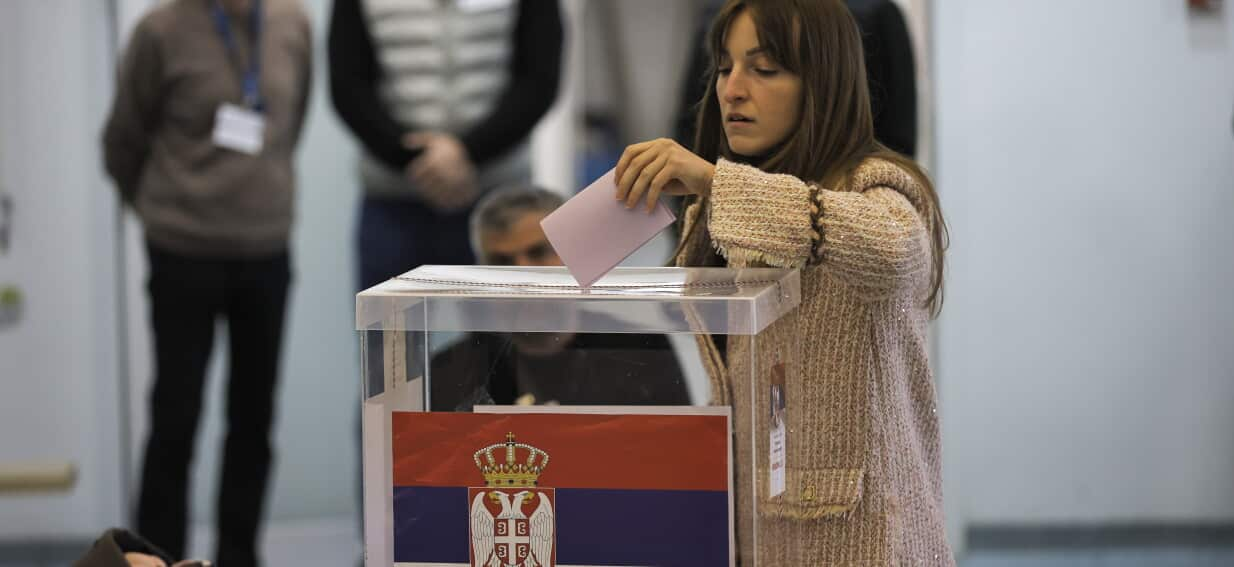
A youth-led political insurgence has brought a historic end to Serbian President Aleksandar Vucic’s 14-year populist rule, clearing the way for a dramatic realignment in Balkan politics.
A seismic upset for the populist establishment
In one of Europe’s most consequential political upsets this year, the entrenched apparatus of Serbia’s ruling populist coalition has crumbled at the ballot box. SBS News Top Stories reported that President Aleksandar Vucic’s ruling party failed to overcome a formidable electoral surge mounted by the newly formed Student’s List, concluding more than a decade of near-total control over state institutions.
Official preliminary counts confirmed that the youth movement secured a decisive plurality, drawing significant turnout from metropolitan hubs and regional working-class districts alike. For Mr Vucic, who has maintained an iron grip over the nation’s political landscape through shifting roles as prime minister and president since 2012, the defeat marks a sudden reckoning. Despite state resources, widespread media access, and extensive patronage networks, the ruling party was ultimately outpaced by a grassroots campaign that converted deep-seated public fatigue into a historic democratic mandate.
University halls to parliamentary benches
The catalyst for this political transformation emerged not from traditional political parties, but from lecture theatres and civic halls across Belgrade, Novi Sad, and Nis. The Student’s List began as a series of coordinated university protests before coalescing into a disciplined civic platform aimed at dismantling state-aligned media monopolies, restoring judicial independence, and combating systemic corruption.
Public frustration had intensified over recent years, exacerbated by institutional inertia, rising living costs, and contentious infrastructure projects. While previous attempts by established opposition parties repeatedly fractured along ideological lines, the student movement deliberately sidestepped partisan dogmatism. By focusing squarely on democratic renewal, institutional integrity, and public accountability, the campaign galvanised hundreds of thousands of first-time and previously disaffected voters, delivering turnout rates unseen in federal polls for more than two decades.
Geopolitical ripples across the Western Balkans
The shock defeat introduces immediate uncertainty to Serbia’s delicate foreign policy posture. Under Mr Vucic, Belgrade sustained a careful diplomatic balancing act, formally pursuing European Union accession while maintaining close ties with Moscow and securing significant commercial partnerships with Beijing.
Western capitals, which had frequently tolerated domestic democratic backsliding in exchange for perceived regional stability, will now be compelled to engage with an unproven political force. Diplomatic analysts indicate that the incoming administration will face swift expectations to revitalise dialogue with neighbouring Kosovo and accelerate judicial reforms necessary for European integration, potentially weakening the strategic foothold long enjoyed by foreign autocratic patrons.
The arduous path to coalition governance
Despite the celebrations filling central Belgrade, the transition presents steep legislative and administrative hurdles. The Student’s List must now navigate complex negotiations to assemble a viable governing majority, harmonising disparate reformist factions with differing economic and social agendas.
Furthermore, reforming a sprawling public sector conditioned by 14 years of partisan appointments will require sustained legislative resolve. As supporters packed Republic Square into the early hours, the incoming leadership acknowledged that unseating an entrenched regime was merely the opening chapter of a demanding democratic reconstruction.