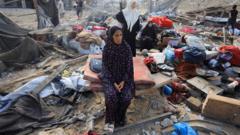
Hundreds of mourners converged on a city in northwestern Iran today, their grief palpable as they laid to rest members of the elite Revolutionary Guard Corps (IRGC). The ceremony follows what Tehran has vehemently denounced as a US strike, an act that threatens to further destabilise an already volatile Middle East.
The sombre proceedings, documented by Al Jazeera, saw residents lining the streets, draped in black, to pay their respects to the fallen. The scale of the attendance underscores the national significance attached to these deaths, perceived by many within Iran as a direct affront by a long-standing adversary.
Tehran Labels Incident 'Act of Aggression'
Iranian state media has been swift and unambiguous in its condemnation, characterising the alleged operation as an unprovoked act of aggression by the United States. While details surrounding the precise nature and location of the strike remain opaque — with neither side offering comprehensive corroboration or denial of specific engagements — the narrative emanating from Tehran is one of righteous indignation.
Analysts in Canberra are closely monitoring the situation, noting the immediate and robust response from Iranian officials. Anonymous sources from within the Department of Foreign Affairs and Trade (DFAT) indicated concerns regarding potential escalations, particularly given the already heightened state of alert across the region following months of proxy conflicts and naval incidents in the Red Sea.
Calls for Retribution Echo Through Streets
The funerals were not just a display of sorrow but also a platform for calls for vengeance. Chants of 'Death to America' and 'Justice for our Martyrs' reportedly reverberated through the crowds, reflecting a deep-seated anti-Western sentiment that is often mobilised during times of perceived external threats. These public outcries, while not uncommon in such circumstances, add to the diplomatic tightrope walk faced by international powers seeking to de-escalate tensions.
Local religious leaders, addressing the bereaved families and the assembled populace, spoke of the deceased as heroes and martyrs, vowing that their sacrifices would not be in vain. Such rhetoric, typically employed in Iranian political discourse, plays a significant role in shaping public opinion and galvanising support for potential retaliatory actions. The economic impact of potential retaliatory measures remains a key concern for global markets, with a barrel of Brent crude oil already trading around AUD$120.
Regional Implications and Global Watch
The incident comes at a critical juncture for regional stability. The Middle East has been a hotbed of geopolitical friction, with Iran and the US often at opposing ends of various conflicts, from Yemen to Syria. An alleged direct strike by the US against IRGC personnel marks a worrying escalation, moving beyond proxy engagements to a potentially more direct confrontation.
International bodies, including the United Nations, are expected to issue statements urging restraint and calling for an independent investigation into the alleged strike. For Australia, a staunch ally of the United States, the situation presents a complex diplomatic challenge. While reaffirming its alliance commitments, the government will undoubtedly advocate for de-escalation to prevent a wider conflict that could have severe global economic and humanitarian repercussions. The coming weeks will be crucial in determining whether this incident heralds a new, more dangerous phase in US-Iran relations or if diplomatic channels can once again avert a full-blown crisis.