
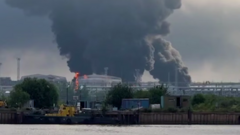
Ukrainian forces have launched a daring long-range drone attack on a major oil terminal near St. Petersburg, Russia, striking a critical energy facility situated almost 1,000 kilometres from the Ukrainian border. The assault marks a notable expansion of Kyiv's targeting strategy, aiming to disrupt the infrastructure generating revenue for Russia's ongoing conflict.
The audacious operation was confirmed by Ukrainian President Volodymyr Zelensky, who declared the target was integral to Russia’s war efforts. While specific details of the drone types and launch locations remain cloaked in operational secrecy, the sheer distance travelled by the unmanned aerial vehicles underscores Ukraine's growing capabilities in precision long-range strikes. Moscow initially reported the downing of drones over the Leningrad region, but later conceded an incident at the terminal, albeit downplaying its significance.
Putin's Backyard Breached
The targeting of an installation near St. Petersburg, Russian President Vladimir Putin’s hometown, sends a potent message to the Kremlin. It demonstrates Ukraine's capacity to reach deep into Russian territory, potentially increasing pressure on Russia's air defence systems and diverting resources from the front lines. The Ust-Luga terminal, operated by Novatek, Russia's largest independent natural gas producer, is a crucial hub for exporting refined petroleum products such as jet fuel, fuel oil, and diesel. A prolonged disruption at such a facility could have tangible economic repercussions for Russia, impacting its ability to fund military operations.
BBC World reported that the attacks signal a deliberate strategy by Ukraine to degrade Russia's economic and military logistical capabilities. Previous Ukrainian drone attacks have largely focused on targets closer to the border or within occupied territories, making this an unprecedented reach. Analysts suggest that the psychological impact within Russia, demonstrating the vulnerability of seemingly secure areas, could be as significant as any material damage.
Unpacking the Economic Impact
The Ust-Luga complex, situated on the Baltic Sea, is an indispensable part of Russia's energy export infrastructure. Disruptions here directly threaten Russia’s capacity to export oil and gas products to international markets, a primary source of national income. While the immediate extent of the damage and its long-term implications are still being assessed, even temporary closures or reduced throughput can translate into substantial financial losses for Moscow. Australia, like many nations, monitors global energy markets closely, and any sustained hit to Russian exports could ripple through supply chains, potentially influencing global oil prices – a factor that eventually impacts Australian petrol bowsers.
Experts suggest that by targeting key revenue-generating infrastructure, Ukraine aims to diminish Russia's financial capacity to sustain its war machine. This strategy aligns with Western sanctions, which have also sought to cripple Russia's economy. The cost of replacing or repairing damaged infrastructure, coupled with potential losses from halted exports, could amount to hundreds of millions of Australian dollars, adding further strain to Russia's already stretched wartime budget.
A New Front in Cyber and Air
Beyond drone strikes, the conflict has also seen a relentless cyber front, with both sides engaging in digital warfare. However, the use of sophisticated drones capable of such long-range missions represents a tangible escalation in the physical domain. This tactic aims to create a sense of insecurity within Russia, forcing it to expend resources on homeland defence rather than offensive operations in Ukraine. The evolving nature of these attacks highlights Ukraine's adaptability and its commitment to finding innovative ways to counter Russia's larger military might. With global attention firmly fixed on the conflict, such high-profile strikes inevitably draw international scrutiny and maintain pressure on Russia to de-escalate.