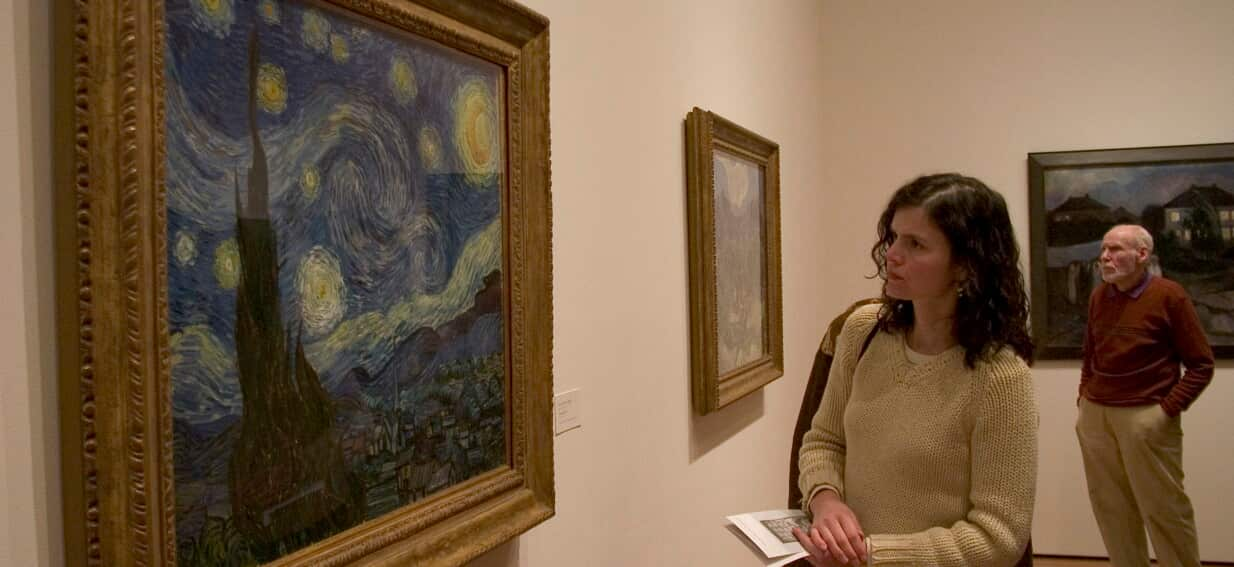
More than 130 years after Vincent van Gogh committed his swirling nocturnal vision to canvas, researchers have unravelled a fresh scientific puzzle hidden within the Dutch master’s most celebrated masterpiece.
The post-impressionist oil painting, completed in 1889 during van Gogh’s confinement at the Saint-Paul-de-Mausole asylum in southern France, has long enchanted viewers with its pulsating blue and yellow firmament. Now, as SBS News Top Stories reported, scientists examining the work have applied modern forensic analysis to decipher the physical laws underpinning its mesmerising, undulating sky.
The mathematical precision of celestial brushwork
What was once dismissed by early critics as the manic hallucination of a tormented mind is increasingly viewed through the lens of rigorous physics. Using high-resolution digital scans, fluid dynamics specialists analysed the scale, direction, and relative luminescence of individual brushstrokes across the canvas.
Their inquiry focused on whether the swirling vortices depicted above the slumbering French village conformed to true atmospheric flow. Remarkably, the statistical properties of van Gogh’s paint strokes were found to align closely with Kolmogorov’s theory of hydrodynamic turbulence, a mathematical principle describing energy cascade in fluids that was only formulated decades after the painter's death.
Atmospheric physics meets post-impressionist genius
The scientific examination did not end with large-scale wind patterns. When investigators assessed the fine, detailed application of paint, they observed that the micro-scale diffusion of pigment echoed Batchelor’s law, which governs how passive scalars disperse within turbulent fluids.
The revelation suggests van Gogh possessed an extraordinary, intuitive comprehension of natural phenomena. Rather than merely embellishing the night sky with decorative flourishes, the artist appears to have captured the kinetic energy of moving air with uncanny realism. Meteorologists have noted that the atmospheric conditions outside the asylum during June 1889, characterised by the fierce Mistral winds of Provence, likely provided van Gogh with an active laboratory of atmospheric turbulence.
Bridging asylum seclusion and modern fluid dynamics
The study sheds fresh light on the intersection of mental vulnerability and perceptual clarity. Painted during an agonising chapter of van Gogh's life, the masterpiece demonstrates that his cognitive faculties and observational acuity remained remarkably sharp, despite recurring bouts of psychiatric distress.
Art conservators believe such multi-spectral and physical insights will also assist preservation efforts. Understanding the physical topography and density of the oil layers allows curators to monitor structural fatigue and micro-cracking across works of comparable antiquity, whose cultural and financial values easily reach hundreds of millions of dollars on the global market.
While the canvas remains safely housed at the Museum of Modern Art in New York, its technical secrets continue to captivate researchers worldwide. As contemporary physics deepens its interrogation of historic cultural artefacts, van Gogh’s celestial masterpiece proves that the boundary between artistic intuition and empirical truth is far more porous than previously understood.