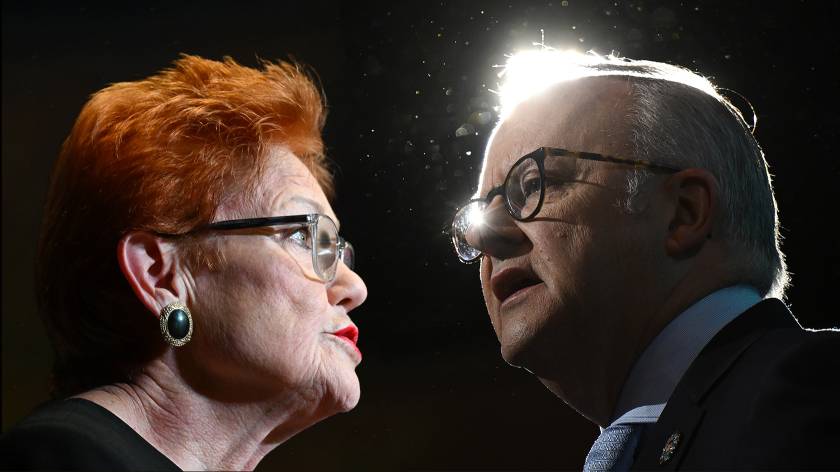
Prime Minister Anthony Albanese may face a less combative Senate than anticipated if Pauline Hanson’s One Nation expands its footprint, with political analysts highlighting the party’s historical reluctance to conduct rigorous legislative scrutiny.
A Crossbench Reprieve for Labor
While conventional political wisdom suggests an influx of right-wing populists would paralyse a centre-left administration, independent outlet Crikey reported that government strategists may view the prospect with private relief. The central premise is that an enlarged One Nation bloc would dilute the influence of detail-driven independent crossbenchers and the Australian Greens, whose forensic examination of government bills frequently delays or rewires Labor's policy agenda.
Senator Pauline Hanson and her parliamentary team have long leaned heavily into culture-war rhetoric and broad populist platforms rather than exhaustive committee work. For ministerial minders and Senate tacticians, dealing with parliamentarians who prioritise symbolic grievances over line-by-line legislative redrafts is often far simpler than negotiating complex policy trade-offs.
The Contrast in Committee Scrutiny
The current 76-seat Upper House requires the government to secure the backing of the Greens alongside at least one independent, or navigate intricate arrangements featuring the likes of ACT independent David Pocock and the Jacqui Lambie Network.
These unaligned lawmakers have built a reputation for demanding extensive departmental briefings, economic modelling, and statutory compromises on landmark industrial relations, environmental, and housing packages. In contrast, Crikey noted that One Nation has routinely demonstrated a disinterest in the gruelling mechanics of Senate estimates and technical legislative committees.
Historically, One Nation senators have often voted alongside the government of the day on procedural motions or failed to propose comprehensive alternative statutory regimes. When complex legislation enters the chamber, the absence of forensic line-by-line cross-examination dramatically lowers the legislative cost and political friction for the Albanese ministry.
Electoral Arithmetic and the Upper House
With half of the Senate facing the ballot box at the next federal election, minor parties on both political flanks are positioning to capture disaffected voters drifting from the major parties. Should One Nation capture additional Senate seats in outer-suburban or regional heartlands, the arithmetic of the balance of power will change dramatically.
Yet, as Crikey observed, a chamber with more populist firebrands could prove far less exhausting for government whips than one dominated by persistent crossbench technocrats. While the public rhetoric between Hanson and the Prime Minister remains thoroughly adversarial, the parliamentary realities of the red chamber suggest a different story: a government capable of quietly passing its legislative program amid populist political theatre, largely spared from forensic oversight.