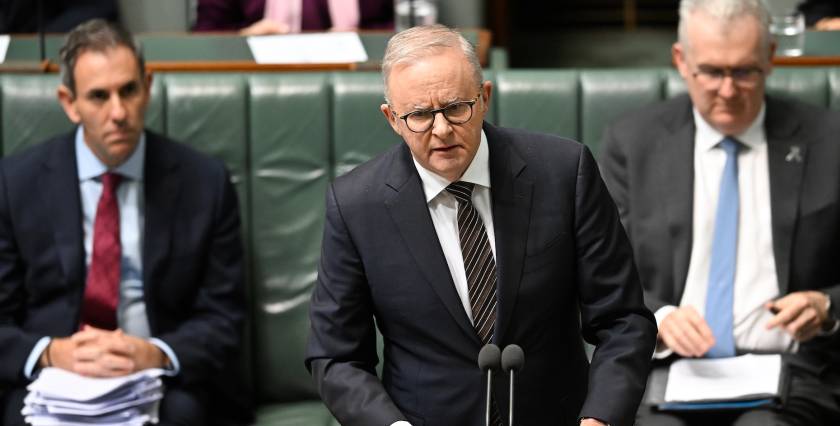
Prime Minister Anthony Albanese is preparing for another international departure, leaving Treasurer Jim Chalmers to absorb intensifying domestic criticism over persistent inflation and Australia's fragile economic trajectory.
As reported by independent news outlet Crikey, the Prime Minister’s impending travel schedule has revived scrutiny over the distribution of political risk within the federal cabinet, with Dr Chalmers left anchored in Canberra to manage mounting voter frustration over the national accounts.
The optics of frequent prime ministerial journeys abroad have long tested public patience during periods of domestic financial distress. With mortgage holders facing sustained high cash rates and real wages only tentatively recovering, the government faces a challenging political terrain as household budgets remain severely squeezed.
Fiscal heat intensifies on Chalmers
Dr Chalmers has shouldered the primary responsibility of defending the administration's fiscal posture, maintaining that public spending restraint and targeted relief are moderating inflation without tipping the nation into recession. However, political opponents and market economists continue to question whether federal budgetary settings are sufficiently disciplined.
The Treasurer remains on a narrow path between funding vital services and avoiding fiscal stimulus that could force the Reserve Bank of Australia to keep borrowing costs elevated. While Dr Chalmers confronts the immediate political blowback on the home front, the Commonwealth is also pushing forward on several complex, long-term regulatory fronts.
Guardrails for artificial intelligence and copyright
Beyond the immediate macroeconomic debate, the Albanese government is readying a refreshed regulatory strategy to tackle rapid developments in artificial intelligence and intellectual property law.
Crikey reported that ministers are formulating new plans to modernise Australia's copyright regime in response to large language models scraping domestic creative works without explicit consent or compensation. The creative and publishing sectors have lobbied fiercely for enforceable safeguards, arguing that unconstrained data harvesting threatens the viability of local journalism and cultural production.
The emerging federal approach seeks to establish statutory boundaries that protect artists and rights holders while ensuring Australian firms are not locked out of global machine-learning advancements. Industry consultations have highlighted deep frictions between protecting existing intellectual property and fostering domestic technological productivity.
Energy demands shape data centre blueprint
Simultaneously, the Commonwealth is drafting planning frameworks to determine where future computing infrastructure should be established. The rapid rise of generative computing has triggered an unprecedented rush to construct hyperscale data centres across the eastern seaboard.
These facilities place immense demands on regional water reserves and the national electricity grid, prompting cabinet to consider centrally coordinated planning guidelines. Rather than permitting unrestrained construction in congested metropolitan fringes, policymakers are examining locations that align directly with emerging renewable energy zones and surplus grid transmission capacity.
Navigating these industrial and technological transformations will demand sustained legislative attention. Yet for the broader electorate, digital policy frameworks remain secondary to the cost of groceries and utility bills—an immediate reality Dr Chalmers must manage on his own while the Prime Minister represents Australia abroad.