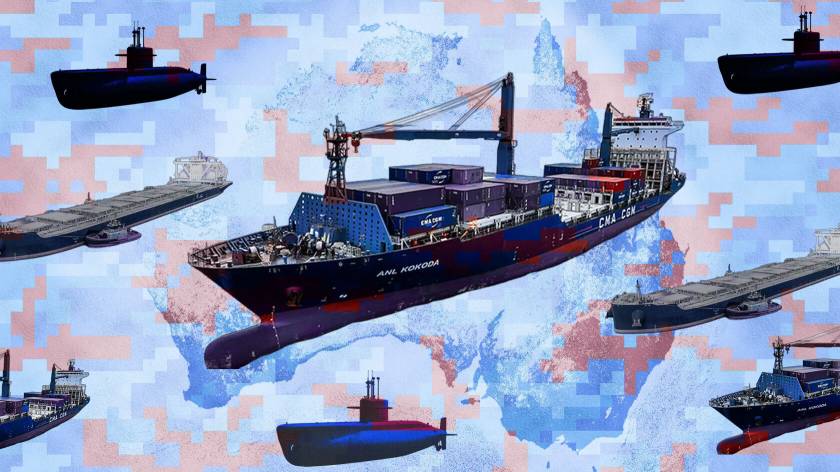
The federal government’s core justification for multi-billion-dollar naval expansion—protecting Australia’s sea trade—has set the Royal Australian Navy up for catastrophic strategic failure, an independent analysis has warned.
According to an assessment published by Crikey, the strategic mandate repeatedly cited by Canberra ministers and defence planners—that the Australian Defence Force must secure maritime trade routes across the Indo-Pacific—is an operational impossibility that masks fundamental contradictions in national defence policy.
The arithmetic of impossible sea lanes
Australia’s economic survival depends heavily on maritime trade, with more than 98 per cent of imports and exports moving by sea. However, Crikey reported that the expectation for the Royal Australian Navy (RAN) to physically patrol and protect these expansive sea lines of communication defies basic military arithmetic.
The sheer vastness of the Indian and Pacific oceans dwarfs the surface and sub-surface capabilities of Australia’s fleet. At present, the RAN operates just eleven major surface combatants—three Hobart-class destroyers and eight ageing Anzac-class frigates—alongside six Collins-class submarines.
Even under ambitious future fleet plans, which include the prospective procurement of general-purpose frigates and tier-two vessels, the navy lacks the hulls required to establish continuous presence along commercial shipping lanes that span thousands of nautical miles, let alone escort commercial bulk carriers during a major regional conflict.
A convenient shield for AUKUS costs
The trade-protection narrative has nonetheless served as a potent political instrument. Crikey argued that the mission has become a convenient justification for the Commonwealth’s headline defence acquisitions, most notably the $368 billion AUKUS nuclear-powered submarine program.
Advocates have frequently framed nuclear-powered submarines as vital tools to keep vital sea lanes open. Yet naval analysts note that SSNs are stealthy strike platforms designed for offensive sea denial and intelligence collection, rather than convoy escort operations.
By tethering public justifications for the historic expenditure to commercial trade security, policymakers have created an expectation that the fleet cannot meet, effectively retrofitting strategic rationale to justify pre-selected hardware.
Strategic disconnect with economic reality
Crikey also highlighted the profound geopolitical paradox underpinning the trade doctrine: Australia’s primary maritime trading partner is also its primary prospective adversary.
The overwhelming majority of Australia’s outbound bulk commodity shipments—predominantly iron ore, liquefied natural gas, and coal—transit directly to East Asian ports, primarily China. In the event of a great-power conflict that severs those routes, Australian warships would absurdly be charged with protecting trade bound for the very power disrupting it.
Furthermore, Australia possesses virtually no sovereign merchant fleet. The vessels carrying domestic exports are foreign-owned and foreign-flagged, complicating any legal or operational framework for RAN escort operations during contested conditions.
Resilience over distant escorts
The critique suggests that rather than chasing an unachievable doctrine of open-ocean trade protection, Canberra’s strategic focus would be better directed toward domestic resilience.
Security specialists have long argued that Australia’s primary maritime vulnerability lies in imported refined fuels, pharmaceuticals, and manufacturing inputs. Addressing these deficits through expanded strategic stockpiles, fuel reserves, and onshore processing would diminish national exposure far more effectively than dispersing an already overstretched surface fleet across distant oceanic corridors.