
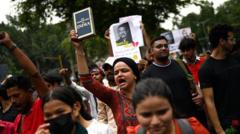
NEW DELHI: Thousands of students demonstrating for sweeping education reforms in India have reportedly been met with a forceful police response, as authorities moved to block their march on the nation's parliament. The confrontations, which BBC World reported led to injuries among protesters, underscore rising tensions over academic opportunities and government policy in the world's most populous nation.
The large-scale demonstration saw students, many travelling long distances to reach the capital, New Delhi, converge with a list of demands ranging from increased funding for public universities to a re-evaluation of current examination systems. Organisers claimed the peaceful assembly was intended to highlight the plight of countless young Indians facing an anachronistic and under-resourced education sector struggling to keep pace with global standards.
Crackdown in the Capital
Security forces erected barricades and deployed a significant police presence across key arteries leading to the Parliament House, effectively sealing off the protest route. Eyewitness accounts, relayed by BBC World, describe scenes of chaos as police used water cannons and batons to disperse the crowds when demonstrators attempted to breach the cordons. Several protesters, some reportedly suffering minor injuries, accused authorities of excessive force. “We are only asking for our future,” one unnamed student was quoted as saying, “and they treat us like criminals.”
The police, however, maintained that the measures were necessary to prevent a breach of security at a protected government precinct and to maintain public order. They asserted that the protest had not been officially sanctioned, a common tactic used by Indian authorities to curtail large-scale demonstrations, and that protesters were warned before force was deployed. Critics argue such pre-emptive bans stifle legitimate dissent.
Demands for a Brighter Future
The students' grievances are multifaceted, touching upon issues that resonate deeply across India's youth demographic. Paramount among their demands is a call for greater government investment in the public education system, which many feel has been neglected in favour of private institutions. They argue that exorbitant fees for quality education are creating an increasingly unequal society, where opportunities are dictated by economic standing rather than merit.
Another significant point of contention is the current examination system, which many students describe as overly stressful, reliant on rote learning, and failing to adequately prepare them for the modern workforce. They advocate for reforms that foster critical thinking, creativity, and practical skills, aligning education more closely with national and international job markets.
A Nation's Unrest
This latest protest comes against a backdrop of increasing youth unemployment and economic uncertainty, issues that have fuelled discontent across various sectors of Indian society. With a vast and rapidly growing youth population, the pressure on the education system to deliver quality outcomes and tangible career pathways is immense. The government of Prime Minister Narendra Modi has made educational reform a stated priority, but critics contend that progress has been slow and insufficient to address the systemic challenges.
Previous estimates suggest India will need to educate over 10 million new job seekers every year to keep pace with its demographic dividend. Failure to do so risks creating a generation of disillusioned youth, something analysts warn could have significant long-term social and economic repercussions for the subcontinent. The clashes in New Delhi serve as a stark reminder of the simmering frustrations underlying India's developmental narrative.