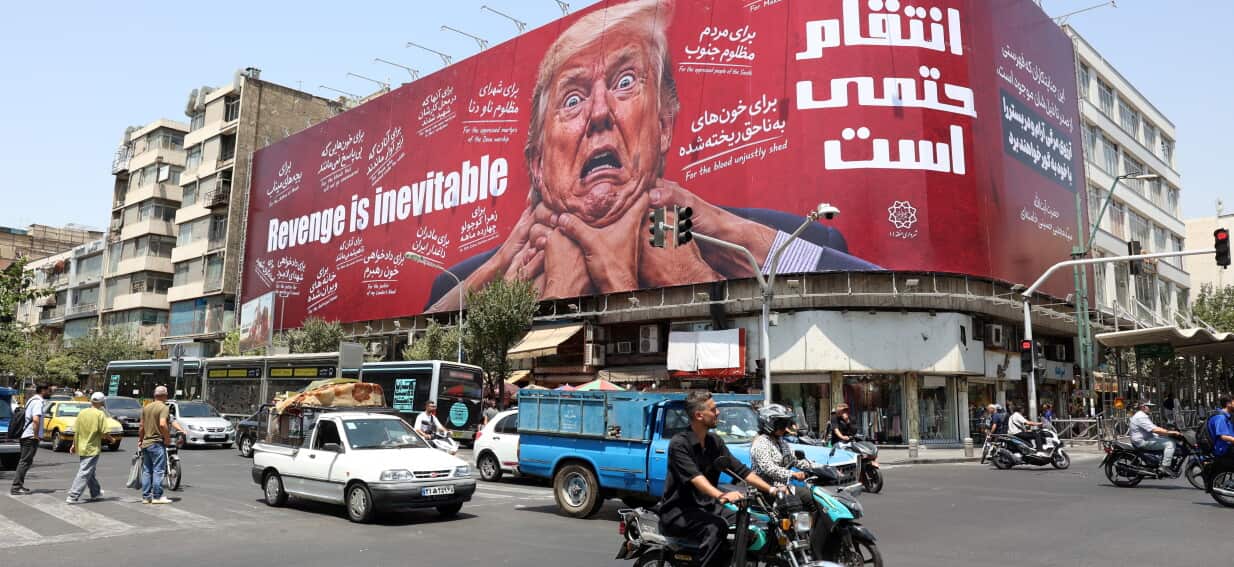
US President Donald Trump has signalled a potential off-ramp in the escalating standoff with Iran, declaring that a "swift deal" could lead to the "Immediate, Complete and Total" reopening of the strategically vital Strait of Hormuz. The pronouncement, delivered via his preferred social media channel, comes amidst heightened fears of military confrontation following a series of incidents in the Persian Gulf region.
Trump's statement suggests a shift in rhetoric, moving away from explicit threats of retaliation towards an olive branch, albeit one conditioned on rapid negotiation. The Strait of Hormuz, a narrow waterway between Iran and Oman, is a critical chokepoint for global oil shipments, with an estimated 20 per cent of the world's petroleum passing through it daily. Its closure, or even significant disruption, would have profound economic ramifications, potentially sending crude oil prices soaring and impacting Australian motorists at the bowser.
Diplomacy over Destabilisation
The US President's sudden pivot towards a diplomatic resolution follows weeks of mounting pressure and bellicose language. Earlier this month, the White House announced new sanctions targeting Iran's supreme leader and other top officials, further ratcheting up economic pressure. However, Trump's latest remarks, reported by SBS News Top Stories, indicate a desire to avoid a protracted military engagement, instead prioritising a negotiated settlement that would guarantee freedom of navigation in the crucial maritime corridor.
Analysts suggest this softer tone could be a response to domestic and international calls for de-escalation, as well as a recognition of the significant risks an open conflict with Iran would pose. The prospect of a "swift deal" aims to leverage economic sanctions as a bargaining chip, compelling Tehran to return to the negotiating table and agree to terms that would secure the Strait.
Global Economic Implications for Australia
The stability of the Strait of Hormuz directly impacts Australia's economic interests. A significant disruption to oil flows would likely translate to higher fuel prices for Australian consumers, impacting household budgets and business operating costs. While Australia sources much of its oil from Asia, global price spikes would inevitably be felt domestically. A barrel of Brent crude, the international benchmark, currently hovers around the AUD$90-$100 mark, and any instability in the Gulf could see that figure jump significantly.
Beyond fuel, broader geopolitical instability in the Middle East has implications for global trade routes and investor confidence, which could indirectly affect Australia's export-driven economy. Maintaining open and secure shipping lanes is paramount for Australian businesses engaged in international trade, reinforcing the importance of a diplomatic resolution to the current tensions.
The Path to a Deal
While President Trump's declaration offers a glimmer of hope, the specifics of a potential "swift deal" remain unclear. It is widely understood that the US seeks a comprehensive agreement that addresses Iran's nuclear program, ballistic missile development, and its regional influence. Iran, on the other hand, demands the lifting of crippling sanctions as a prerequisite for any meaningful negotiations.
The challenge lies in bridging this significant gap in demands. Both sides appear to be testing the other's resolve, with the Strait of Hormuz becoming a focal point of this high-stakes geopolitical chess match. For Australia and the wider international community, the hope is that President Trump's call for a "swift deal" genuinely paves the way for constructive dialogue and a peaceful resolution to a crisis that has the potential to destabilise the global economy.