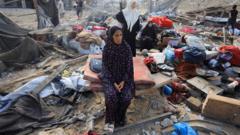
SINJIL, Occupied West Bank – Life for the Palestinian residents of Sinjil in the occupied West Bank has been dramatically curtailed after Israeli authorities implemented a series of stringent road closures, effectively barricading all main entrances to the village. The moves, reported by Al Jazeera, have plunged the community into a deepening humanitarian and economic crisis, reigniting concerns over the collective punishment of Palestinian populations in the territories.
Sinjil, a village strategically located north of Ramallah, now finds its approximately 6,000 inhabitants facing arduous detours and significant delays for even the most basic necessities. What were once short, direct routes to neighbouring towns, schools, and hospitals have been replaced by circuitous and often unpaved tracks, adding hours to journeys and imposing an unprecedented burden on daily life.
Community Under Siege
The impact of the blockades extends far beyond mere inconvenience. Farmers, a significant portion of Sinjil's workforce, are struggling to transport their produce to markets, leading to mounting financial losses and the spoilage of valuable crops. Students face increased difficulty reaching educational institutions outside the village, jeopardising their academic futures. Perhaps most critically, medical emergencies now pose an existential threat, with ambulances facing critical delays in reaching hospitals, potentially costing lives. Residents speak of a growing sense of isolation and despair, feeling increasingly disconnected from the wider West Bank and their fundamental rights to freedom of movement.
Local authorities in Sinjil, speaking to Al Jazeera, described a community under siege. They highlighted the psychological toll these restrictions are taking on families, particularly children, who are witnessing their lives shrink under the shadow of concrete barriers and military checkpoints. The economic repercussions are also stark, with small businesses teetering on the brink of collapse as customer access is choked off and supply chains are disrupted. The cost of living is set to soar as goods become harder and more expensive to import into the isolated village.
Australian Calls for De-escalation
The situation in Sinjil is emblematic of broader patterns of Israeli restrictions on Palestinian movement within the West Bank, often implemented in response to security incidents. While Israeli authorities routinely state such measures are necessary for security, human rights organisations frequently decry them as disproportionate and a form of collective punishment that violates international law. Australia, through its Department of Foreign Affairs and Trade (DFAT), has consistently called for de-escalation of tensions in the West Bank and for all parties to respect international humanitarian law. A DFAT spokesperson, when previously questioned on similar incidents, reiterated Australia’s commitment to a two-state solution and the importance of unimpeded humanitarian access.
Echoes of Past Restrictions
This is not the first time Sinjil has faced such stringent closures. The village, like many others in the West Bank, has intermittently experienced various forms of blockades, closures, and checkpoints since the beginning of the Israeli occupation in 1967. However, the current extent of the closures, blocking all main entrances simultaneously, appears to represent a significant escalation in the level of restriction imposed by the Israeli military. The memory of past hardships, including economic downturns and limited access to essential services, weighs heavily on residents who fear a return to even more difficult times. The continuous cycle of restrictions and limited access stunts development and perpetuates reliance on external aid, undermining efforts towards self-sufficiency within Palestinian communities.
An Uncertain Future
With no indication of when these blockades might be lifted, the future for Sinjil remains uncertain. The humanitarian implications are significant, as are the long-term effects on the village’s social and economic fabric. International observers, including United Nations agencies, have previously criticised such restrictive measures, citing their detrimental impact on Palestinian livelihoods and fundamental human rights. The international community continues to monitor the deteriorating situation in the West Bank, with calls for Israel to uphold its obligations under international law and ensure the free movement of Palestinian civilians. For the people of Sinjil, however, these calls offer little immediate relief as they navigate a path that has become increasingly narrow and fraught with difficulty.